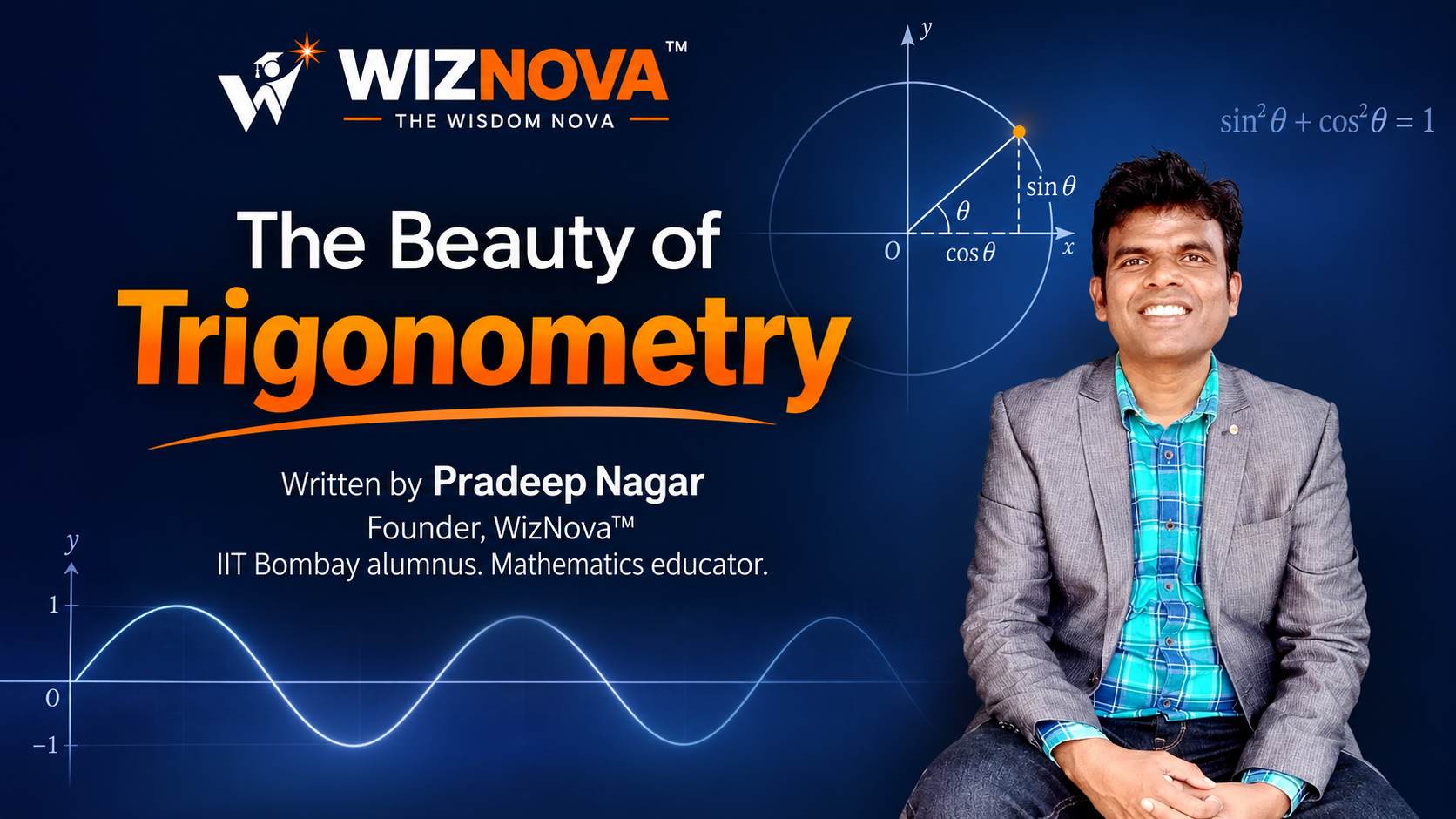
The Beauty of Trigonometry
From triangles to circles, vectors, graphs and equations — discover the connections that make Trigonometry one of the most beautiful structures in Mathematics.
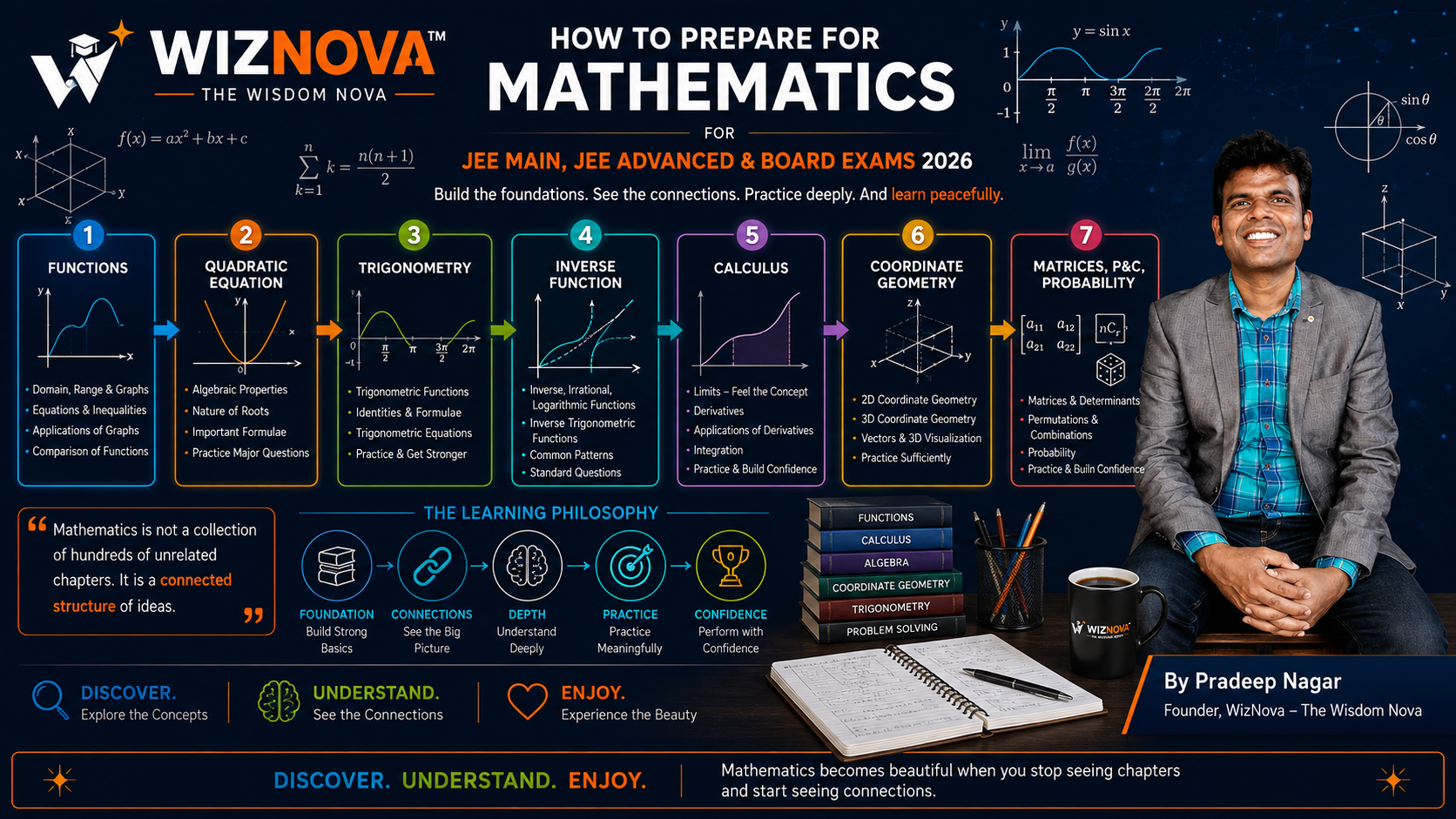
Build the foundations. See the connections. Practise deeply. And learn peacefully.
Trigonometry should not be approached as a collection of hundreds of formulae. It is a connected mathematical structure linking geometry, angles, functions, graphs, vectors, coordinates, equations, calculus and physics.
When you see that connection, the formulae stop being things to memorise. They become things you understand — and can rebuild whenever you need them.
Table of Contents
- Why Was Trigonometry Created?
- The Six Trigonometric Functions
- From Triangle to Vector
- The Unit Circle
- Domain, Range and Graphs of All Six Functions
- Section A — Elementary Trigonometry of a Single Angle
- Section B — Compound Angles
- Sum-to-Product Formulae
- Double Angle Formulae
- Half Angle Formulae
- Triple Angle Formulae
- The Formula Family Tree
- Learn to Generate, Not Memorise
- Trigonometry + Functions + Graphs
- Trigonometry + Vectors
- Trigonometry + Coordinate Geometry
- Trigonometry + Calculus
- How to Study Trigonometry for JEE
- What Should a JEE Student Really Remember?
- The Beauty of Trigonometry
Why Was Trigonometry Created? {#why-was-trigonometry-created}
Ancient astronomers faced a fundamental problem: they needed to determine distances, positions, and angles that could not be measured directly. The Moon, the Sun, the stars — none of these could be reached. But they could be observed. And from observation, with the right mathematics, distances and positions could be calculated.
This is where Trigonometry was born — not in a classroom, but in the sky.
Hipparchus (c. 190–120 BCE) is often credited as one of the earliest systematic developers of trigonometry. He constructed tables of chords — the length of a chord subtended by an angle in a circle — which allowed him to calculate angular distances between celestial objects. His chord tables were the ancient world's equivalent of our modern sine tables.
Did You Know? The word sine has a fascinating history. The Sanskrit word jyā (meaning "bowstring" — the chord of an arc) was transliterated into Arabic as jiba, which was later misread as jaib (meaning "pocket" or "fold"). When Arabic mathematical texts were translated into Latin, jaib became sinus — and sinus became sine.
The development of Trigonometry did not happen in one place or one tradition. It grew across civilisations:
Ancient Astronomy → Angles → Triangles → Chords → Sine → Trigonometric Functions → Unit Circle → Graphs → Modern Mathematics
A particularly important milestone was the work of Āryabhaṭa (476–550 CE), the Indian mathematician and astronomer. His text Āryabhaṭīya contains one of the earliest known sine tables, computed for angles in steps of 3.75°. Āryabhaṭa worked with ardha-jyā (half-chord), which is the direct ancestor of the modern sine function.
The development continued through Islamic mathematics (Al-Battani, Al-Biruni), through European Renaissance mathematics, and eventually into the modern function-based framework we use today.
The purpose of this history: Trigonometry was not invented to torture students with formulae. It was invented to solve real mathematical problems — measuring the unmeasurable. When you understand this, the subject begins to feel different.
The Six Trigonometric Functions {#the-six-trigonometric-functions}
Begin with a right-angled triangle. Let θ be one of the acute angles.
Label the three sides relative to θ:
- Opposite — the side directly across from θ
- Adjacent — the side next to θ (not the hypotenuse)
- Hypotenuse — the longest side, opposite the right angle
The six trigonometric functions are defined as:
| Function | Definition | Ratio |
|---|---|---|
| sin θ | Opposite / Hypotenuse | O/H |
| cos θ | Adjacent / Hypotenuse | A/H |
| tan θ | Opposite / Adjacent | O/A |
| cosec θ | Hypotenuse / Opposite | H/O |
| sec θ | Hypotenuse / Adjacent | H/A |
| cot θ | Adjacent / Opposite | A/O |
Notice immediately: cosec, sec, cot are reciprocals of sin, cos, tan respectively.
cosec θ = 1 / sin θ
sec θ   = 1 / cos θ
cot θ   = 1 / tan θ
And the quotient relations:
tan θ = sin θ / cos θ
cot θ = cos θ / sin θ
Key Insight: You do not have six independent functions. You have two fundamental projections — sin and cos — and four functions derived from them. Everything else follows.
Standard angle values — memorise these, they appear everywhere:
| θ | 0 | π/6 | π/4 | π/3 | π/2 |
|---|---|---|---|---|---|
| sin θ | 0 | 1/2 | 1/√2 | √3/2 | 1 |
| cos θ | 1 | √3/2 | 1/√2 | 1/2 | 0 |
| tan θ | 0 | 1/√3 | 1 | √3 | undefined |
From Triangle to Vector {#from-triangle-to-vector}
The right-triangle definition works for acute angles (0 < θ < π/2). But what about angles greater than π/2? What about negative angles? What about 7π/3?
To extend Trigonometry to all real angles, we move from triangles to vectors.
Consider a unit vector — a vector of length 1 — making an angle x with the positive x-axis.
Let this vector be u = (cos x, sin x).
Then:
- cos x = the horizontal projection of the unit vector onto the x-axis
- sin x = the vertical projection of the unit vector onto the y-axis
As the angle x increases, the unit vector rotates. Its horizontal and vertical projections change continuously. This is how sine and cosine become functions of all real angles.
The remaining four functions arise naturally:
tan x   = sin x / cos x   (slope of the unit vector)
cot x   = cos x / sin x   (reciprocal slope)
sec x   = 1 / cos x       (reciprocal of horizontal projection)
cosec x = 1 / sin x       (reciprocal of vertical projection)
Signature WizNova Insight: Six functions are different mathematical views of one rotating unit vector. When you see this, the six functions stop being six separate things. They become one thing — a rotating vector — viewed from six different angles.
The Unit Circle {#the-unit-circle}
The unit circle is the circle of radius 1 centred at the origin:
x² + y² = 1
For any angle θ, the point P on the unit circle at angle θ from the positive x-axis has coordinates:
P = (cos θ, sin θ)
This means:
- cos θ = x-coordinate of P
- sin θ = y-coordinate of P
- tan θ = y/x (when x ≠ 0)
Signs in the four quadrants:
| Quadrant | x | y | sin | cos | tan |
|---|---|---|---|---|---|
| I (0 to π/2) | + | + | + | + | + |
| II (π/2 to π) | − | + | + | − | − |
| III (π to 3π/2) | − | − | − | − | + |
| IV (3π/2 to 2π) | + | − | − | + | − |
Mnemonic: "All Students Take Calculus" — All positive in Q1, Sine positive in Q2, Tangent positive in Q3, Cosine positive in Q4.
The Pythagorean Identity from the Unit Circle:
Since every point on the unit circle satisfies x² + y² = 1, and cos θ = x, sin θ = y:
sin²θ + cos²θ = 1
This identity is not an isolated formula. It is geometry written in the language of Trigonometry. The unit circle equation is the Pythagorean identity.
Periodicity: As θ increases by 2π, the point P returns to its original position. Therefore:
sin(θ + 2π) = sin θ
cos(θ + 2π) = cos θ
Sine and cosine have period 2π. Tangent and cotangent have period π.
Domain, Range and Graphs of All Six Functions {#domain-range-and-graphs}
sin x
- Domain: All real numbers ℝ
- Range: [−1, 1]
- Period: 2π
- Zeros: x = nπ, n ∈ ℤ
- Symmetry: Odd function — sin(−x) = −sin x
- Graph shape: Smooth wave oscillating between −1 and 1
cos x
- Domain: All real numbers ℝ
- Range: [−1, 1]
- Period: 2π
- Zeros: x = π/2 + nπ, n ∈ ℤ
- Symmetry: Even function — cos(−x) = cos x
- Graph shape: Same wave as sin x, shifted left by π/2
Connection: cos x = sin(x + π/2). The cosine graph is the sine graph shifted by π/2. They are the same function, viewed from a different starting angle.
tan x
- Domain: ℝ \ {π/2 + nπ : n ∈ ℤ} — all reals except where cos x = 0
- Range: All real numbers ℝ (−∞, +∞)
- Period: π
- Zeros: x = nπ, n ∈ ℤ
- Vertical asymptotes: x = π/2 + nπ (where cos x = 0, so tan x = sin x / cos x is undefined)
- Symmetry: Odd function — tan(−x) = −tan x
Why the asymptotes? tan x = sin x / cos x. When cos x = 0, the denominator is zero. The function blows up to ±∞. This is not a mystery — it is a consequence of the definition.
cot x
- Domain: ℝ \ {nπ : n ∈ ℤ} — all reals except where sin x = 0
- Range: All real numbers ℝ
- Period: π
- Zeros: x = π/2 + nπ
- Vertical asymptotes: x = nπ (where sin x = 0)
- Symmetry: Odd function
sec x
- Domain: ℝ \ {π/2 + nπ : n ∈ ℤ} (same as tan x)
- Range: (−∞, −1] ∪ [1, +∞)
- Period: 2π
- No zeros (|sec x| ≥ 1 always)
- Vertical asymptotes: x = π/2 + nπ
Connection: sec x = 1/cos x. Where cos x has a maximum of 1, sec x has a minimum of 1. Where cos x approaches 0, sec x blows up. The sec graph is the "reciprocal reflection" of the cos graph.
cosec x
- Domain: ℝ \ {nπ : n ∈ ℤ} (same as cot x)
- Range: (−∞, −1] ∪ [1, +∞)
- Period: 2π
- No zeros
- Vertical asymptotes: x = nπ
Summary comparison table:
| Function | Domain | Range | Period | Odd/Even |
|---|---|---|---|---|
| sin x | ℝ | [−1, 1] | 2π | Odd |
| cos x | ℝ | [−1, 1] | 2π | Even |
| tan x | ℝ \ {π/2+nπ} | ℝ | π | Odd |
| cot x | ℝ \ {nπ} | ℝ | π | Odd |
| sec x | ℝ \ {π/2+nπ} | (−∞,−1]∪[1,∞) | 2π | Even |
| cosec x | ℝ \ {nπ} | (−∞,−1]∪[1,∞) | 2π | Odd |
Section A — Elementary Trigonometry of a Single Angle {#section-a-single-angle}
A1 — Reciprocal Relations
sin θ · cosec θ = 1
cos θ · sec θ   = 1
tan θ · cot θ   = 1
A2 — Quotient Relations
tan θ = sin θ / cos θ
cot θ = cos θ / sin θ
A3 — Fundamental Pythagorean Identities
Identity 1:
sin²θ + cos²θ = 1
Proof: From the unit circle, (cos θ, sin θ) lies on x² + y² = 1. Substituting gives sin²θ + cos²θ = 1. ∎
Identity 2:
1 + tan²θ = sec²θ
Proof: Divide Identity 1 by cos²θ (valid when cos θ ≠ 0):
sin²θ/cos²θ + 1 = 1/cos²θ
tan²θ + 1 = sec²θ
∎
Identity 3:
1 + cot²θ = cosec²θ
Proof: Divide Identity 1 by sin²θ (valid when sin θ ≠ 0):
1 + cos²θ/sin²θ = 1/sin²θ
1 + cot²θ = cosec²θ
∎
Key Insight: Identities 2 and 3 are not new facts. They are Identity 1 viewed from two different angles — divided by cos²θ and sin²θ respectively. One identity generates three.
A4 — Complementary Angles (θ and π/2 − θ)
sin(π/2 − θ) = cos θ
cos(π/2 − θ) = sin θ
tan(π/2 − θ) = cot θ
cot(π/2 − θ) = tan θ
sec(π/2 − θ) = cosec θ
cosec(π/2 − θ) = sec θ
The pattern: sin ↔ cos, tan ↔ cot, sec ↔ cosec. The "co-" prefix means "complementary angle version."
Why does this work? In a right triangle with angles θ and (π/2 − θ), the side that is "opposite" to θ is "adjacent" to (π/2 − θ), and vice versa. The geometry forces the swap.
A5 — Supplementary Angles (θ and π − θ)
sin(π − θ) =  sin θ
cos(π − θ) = −cos θ
tan(π − θ) = −tan θ
cot(π − θ) = −cot θ
sec(π − θ) = −sec θ
cosec(π − θ) = cosec θ
Why? On the unit circle, the point at angle (π − θ) is the reflection of the point at angle θ across the y-axis. The y-coordinate (sin) is unchanged; the x-coordinate (cos) changes sign.
A6 — Other Important Angle Transformations
| Transformation | sin | cos | tan |
|---|---|---|---|
| −θ | −sin θ | cos θ | −tan θ |
| π + θ | −sin θ | −cos θ | tan θ |
| π − θ | sin θ | −cos θ | −tan θ |
| 2π − θ | −sin θ | cos θ | −tan θ |
| π/2 + θ | cos θ | −sin θ | −cot θ |
| π/2 − θ | cos θ | sin θ | cot θ |
Memory principle: For transformations involving π/2 or 3π/2, the function name changes (sin ↔ cos, tan ↔ cot, sec ↔ cosec). For transformations involving π or 2π, the function name stays the same. The sign is determined by the quadrant.
A7 — Even and Odd Properties
cos(−θ) =  cos θ    (even function)
sin(−θ) = −sin θ    (odd function)
tan(−θ) = −tan θ    (odd function)
cot(−θ) = −cot θ    (odd function)
sec(−θ) =  sec θ    (even function)
cosec(−θ) = −cosec θ (odd function)
Graphically: Even functions are symmetric about the y-axis. Odd functions have rotational symmetry about the origin.
A8 — Quadrant Signs
Use the unit circle. In each quadrant, determine the sign of x (cos) and y (sin), then derive the signs of all six functions.
| Quadrant | sin | cos | tan | cot | sec | cosec |
|---|---|---|---|---|---|---|
| I | + | + | + | + | + | + |
| II | + | − | − | − | − | + |
| III | − | − | + | + | − | − |
| IV | − | + | − | − | + | − |
Common Mistake: Students sometimes confuse the quadrant of the angle with the sign of the function. Always go back to the unit circle. The sign of sin θ is the sign of the y-coordinate. The sign of cos θ is the sign of the x-coordinate. Everything else follows.
Section B — Compound Angles {#section-b-compound-angles}
B1 — Sine Addition and Subtraction
sin(A + B) = sin A cos B + cos A sin B
sin(A − B) = sin A cos B − cos A sin B
Proof of sin(A + B):
Consider two unit vectors at angles A and B from the positive x-axis. The angle between them is (A − B). Using the distance formula and the cosine rule, one can show:
The distance between points (cos A, sin A) and (cos B, sin B) on the unit circle equals 2sin((A−B)/2) · ...
A cleaner proof uses the rotation matrix. A rotation by angle A followed by a rotation by angle B is a rotation by (A + B). Writing this out in coordinates:
cos(A+B) = cos A cos B − sin A sin B
sin(A+B) = sin A cos B + cos A sin B
This can be verified by expanding the rotation matrix product:
[cos A  −sin A] [cos B  −sin B]   [cos(A+B)  −sin(A+B)]
[sin A   cos A] [sin B   cos B] = [sin(A+B)   cos(A+B)]
The (2,1) entry gives sin(A+B) = sin A cos B + cos A sin B. ∎
For sin(A − B), replace B with −B and use sin(−B) = −sin B, cos(−B) = cos B.
B2 — Cosine Addition and Subtraction
cos(A + B) = cos A cos B − sin A sin B
cos(A − B) = cos A cos B + sin A sin B
Proof: From the rotation matrix derivation above, the (1,1) entry gives cos(A+B) = cos A cos B − sin A sin B. ∎
B3 — Tangent Addition and Subtraction
tan(A + B) = (tan A + tan B) / (1 − tan A tan B)    [provided tan A tan B ≠ 1]
tan(A − B) = (tan A − tan B) / (1 + tan A tan B)    [provided tan A tan B ≠ −1]
Derivation:
tan(A+B) = sin(A+B)/cos(A+B)
         = (sin A cos B + cos A sin B) / (cos A cos B − sin A sin B)
Divide numerator and denominator by cos A cos B:
= (tan A + tan B) / (1 − tan A tan B)
∎
Important condition: The formula is undefined when 1 − tan A tan B = 0, i.e., when tan A tan B = 1. This happens when A + B = π/2 + nπ, i.e., when tan(A+B) itself is undefined.
Sum-to-Product Formulae {#sum-to-product-formulae}
These are derived by adding and subtracting the compound-angle formulae.
Starting point:
sin(A+B) = sin A cos B + cos A sin B   ... (1)
sin(A−B) = sin A cos B − cos A sin B   ... (2)
Adding (1) and (2):
sin(A+B) + sin(A−B) = 2 sin A cos B
Subtracting (2) from (1):
sin(A+B) − sin(A−B) = 2 cos A sin B
Let C = A+B and D = A−B, so A = (C+D)/2 and B = (C−D)/2:
Sum-to-Product:
sin C + sin D = 2 sin((C+D)/2) cos((C−D)/2)
sin C − sin D = 2 cos((C+D)/2) sin((C−D)/2)
cos C + cos D = 2 cos((C+D)/2) cos((C−D)/2)
cos C − cos D = −2 sin((C+D)/2) sin((C−D)/2)
Product-to-Sum:
2 sin A cos B = sin(A+B) + sin(A−B)
2 cos A cos B = cos(A−B) + cos(A+B)
2 sin A sin B = cos(A−B) − cos(A+B)
Connection: Sum-to-product and product-to-sum are not separate formulae. They are the same compound-angle identities, rearranged. Learn the compound-angle formulae well, and these follow immediately.
Double Angle Formulae {#double-angle-formulae}
Set A = B = θ in the compound-angle formulae.
sin 2θ:
sin(θ + θ) = sin θ cos θ + cos θ sin θ
sin 2θ = 2 sin θ cos θ
cos 2θ:
cos(θ + θ) = cos θ cos θ − sin θ sin θ
cos 2θ = cos²θ − sin²θ
Using sin²θ + cos²θ = 1, we get two more equivalent forms:
cos 2θ = 2cos²θ − 1       (replace sin²θ = 1 − cos²θ)
cos 2θ = 1 − 2sin²θ       (replace cos²θ = 1 − sin²θ)
These three forms of cos 2θ are all equivalent. Which one to use depends on the problem.
tan 2θ:
tan 2θ = 2 tan θ / (1 − tan²θ) [provided tan²θ ≠ 1]
Derivation: Set A = B = θ in the tan addition formula.
JEE Connection: The forms cos 2θ = 2cos²θ − 1 and cos 2θ = 1 − 2sin²θ are extremely useful for integration and for solving equations. Recognising when to use which form is a key JEE skill.
Half Angle Formulae {#half-angle-formulae}
From cos 2θ = 1 − 2sin²θ, replace θ with θ/2:
cos θ = 1 − 2sin²(θ/2)
2sin²(θ/2) = 1 − cos θ
sin²(θ/2) = (1 − cos θ) / 2
Therefore:
sin(θ/2) = ± √((1 − cos θ) / 2)
From cos 2θ = 2cos²θ − 1, replace θ with θ/2:
cos θ = 2cos²(θ/2) − 1
cos²(θ/2) = (1 + cos θ) / 2
cos(θ/2) = ± √((1 + cos θ) / 2)
And:
tan(θ/2) = sin(θ/2) / cos(θ/2) = ± √((1 − cos θ) / (1 + cos θ))
Also useful:
tan(θ/2) = sin θ / (1 + cos θ) = (1 − cos θ) / sin θ
Important: The ± sign depends on the quadrant of θ/2. Always determine the quadrant before choosing the sign.
Triple Angle Formulae {#triple-angle-formulae}
Write 3θ = 2θ + θ and apply the compound-angle formulae.
sin 3θ:
sin 3θ = sin(2θ + θ)
       = sin 2θ cos θ + cos 2θ sin θ
       = 2 sin θ cos θ · cos θ + (1 − 2sin²θ) sin θ
       = 2 sin θ cos²θ + sin θ − 2sin³θ
       = 2 sin θ (1 − sin²θ) + sin θ − 2sin³θ
       = 2 sin θ − 2sin³θ + sin θ − 2sin³θ
       = 3 sin θ − 4sin³θ
cos 3θ:
cos 3θ = cos(2θ + θ)
       = cos 2θ cos θ − sin 2θ sin θ
       = (2cos²θ − 1) cos θ − 2 sin θ cos θ · sin θ
       = 2cos³θ − cos θ − 2 sin²θ cos θ
       = 2cos³θ − cos θ − 2(1 − cos²θ) cos θ
       = 2cos³θ − cos θ − 2cos θ + 2cos³θ
       = 4cos³θ − 3cos θ
tan 3θ:
tan 3θ = (3 tan θ − tan³θ) / (1 − 3tan²θ) [provided 3tan²θ ≠ 1]
Key Insight: These are not new isolated formulae. They are generated from the compound-angle formulae by substituting 3θ = 2θ + θ. Higher multiple-angle formulae (sin 4θ, cos 5θ, etc.) can be generated recursively by the same method.
The Formula Family Tree {#formula-family-tree}
Here is the complete structure of Trigonometry, showing how every formula is connected:
Basic Ratios (sin, cos, tan from right triangle)
         ↓
Reciprocal Relations (cosec, sec, cot)
         ↓
Quotient Relations (tan = sin/cos, cot = cos/sin)
         ↓
Pythagorean Identity (sin²θ + cos²θ = 1)
         ↓
Derived Pythagorean Identities (1 + tan²θ = sec²θ, etc.)
         ↓
Compound Angle Formulae (sin(A±B), cos(A±B), tan(A±B))
         ↓
Sum-to-Product / Product-to-Sum Transformations
         ↓
Double Angle Formulae (sin 2θ, cos 2θ, tan 2θ)
         ↓
Half Angle Formulae (sin θ/2, cos θ/2, tan θ/2)
         ↓
Triple Angle Formulae (sin 3θ, cos 3θ, tan 3θ)
         ↓
Multiple-Angle Identities (sin nθ, cos nθ)
         ↓
Trigonometric Equations
         ↓
Graphs and Problem Solving
The purpose of this tree: You do not need to memorise hundreds of disconnected formulae. You need to understand the generating principles at each level. If you know the compound-angle formulae, you can derive everything below them. If you know the Pythagorean identity, you can derive the two identities below it.
Learn to Generate, Not Memorise {#learn-to-generate}
"Can you rebuild the formula?"
This is the most important question in Trigonometry. Not "do you remember the formula?" but "can you rebuild it?"
Example 1: From Identity 1 to Identity 2
sin²θ + cos²θ = 1
÷ cos²θ:
tan²θ + 1 = sec²θ
Example 2: From compound angles to double angles
sin(A+B) = sin A cos B + cos A sin B
Put A = B = θ:
sin 2θ = 2 sin θ cos θ
Example 3: From compound angles to triple angles
sin(2θ + θ) = sin 2θ cos θ + cos 2θ sin θ
            = 3 sin θ − 4sin³θ
Example 4: From double angle to half angle
cos 2θ = 1 − 2sin²θ
Replace θ with θ/2:
cos θ = 1 − 2sin²(θ/2)
sin²(θ/2) = (1 − cos θ)/2
Do not memorise every member of a family when you understand the rule that generates the family.
This is the WizNova philosophy applied to Trigonometry. See the structure. See the generating principle. Then the formulae become natural consequences, not arbitrary facts.
Trigonometry + Functions + Graphs {#trigonometry-functions-graphs}
Trigonometry becomes far more powerful when viewed through the lens of Functions.
The six trigonometric functions are functions in the precise mathematical sense — they take a real number (an angle) as input and produce a real number as output. This means all the machinery of Functions applies:
- Domain and Range — we have already studied these
- Graphs — visual representations of how the output varies with the input
- Equations — finding all x such that f(x) = k
- Inequalities — finding all x such that f(x) > k or f(x) < k
- Transformations — how y = a·sin(bx + c) + d relates to y = sin x
Graphical thinking for equations:
To solve sin x = 1/2, draw the line y = 1/2 and find all intersections with y = sin x. There are infinitely many solutions: x = π/6 + 2nπ and x = 5π/6 + 2nπ for n ∈ ℤ.
The graph makes the infinite family of solutions visible. Without the graph, students often miss solutions or write incorrect general forms.
The connection:
Trigonometry ↔ Functions ↔ Domain ↔ Range ↔ Graphs ↔ Equations ↔ Inequalities
Trigonometry + Vectors {#trigonometry-vectors}
The dot product of two vectors a and b is defined as:
a · b = |a| |b| cos θ
where θ is the angle between them. Therefore:
cos θ = (a · b) / (|a| |b|)
This formula connects:
- Projection — the dot product measures how much of one vector lies along another
- Angle — the angle between two vectors
- Cosine — which began as a ratio in a right triangle
The cosine function, born from a triangle, becomes a tool for measuring angles between vectors in any number of dimensions. This is one of the most beautiful generalisations in Mathematics.
See the connection: Triangle → Ratio → Function → Vector Tool. The same mathematical object, growing in power as the context expands.
Trigonometry + Coordinate Geometry {#trigonometry-coordinate-geometry}
For a point at distance r from the origin, making angle θ with the positive x-axis:
x = r cos θ
y = r sin θ
x² + y² = r²
This is the polar-to-Cartesian conversion. It connects:
- Trigonometry — cos θ and sin θ
- Coordinates — (x, y)
- Circles — x² + y² = r²
- Geometry — distances and angles
Parametric equations of a circle of radius r:
x = r cos t, y = r sin t, t ∈ [0, 2π)
This is the unit circle generalised. As t increases from 0 to 2π, the point (x, y) traces the entire circle exactly once.
Trigonometry + Calculus {#trigonometry-calculus}
The derivatives of the basic trigonometric functions:
d/dx (sin x) =  cos x
d/dx (cos x) = −sin x
d/dx (tan x) =  sec²x
d/dx (cot x) = −cosec²x
d/dx (sec x) =  sec x tan x
d/dx (cosec x) = −cosec x cot x
Notice the beautiful symmetry: differentiating sin gives cos, and differentiating cos gives −sin. Differentiating twice returns you to −sin:
d²/dx² (sin x) = −sin x
This means sin x satisfies the differential equation y'' + y = 0 — the equation of simple harmonic motion. This is why sine and cosine appear everywhere in physics: oscillations, waves, alternating current, quantum mechanics.
The deeper connection: Sine and cosine are not just geometric ratios. They are the natural solutions to the most fundamental oscillation equation in physics. Trigonometry is the mathematics of oscillation.
How to Study Trigonometry for JEE {#how-to-study}
Here is a recommended sequence that builds understanding rather than memorisation:
SEE → Understand the right triangle. Draw it. Label it. Know which side is opposite, adjacent, hypotenuse for a given angle.
UNDERSTAND → Learn the six functions as ratios. Understand why there are exactly six (two projections and their four derived functions).
VISUALISE → Study the unit circle. Understand how sin and cos arise as coordinates. Understand the quadrant signs geometrically.
CONNECT → See that the six functions are six views of one rotating unit vector.
GENERALISE → Extend to all real angles using the unit circle. Understand periodicity.
GRAPH → Draw all six graphs. Understand why each graph has its shape — connect the graph to the unit circle.
DERIVE → Prove the Pythagorean identities. Prove the compound-angle formulae. Derive the double-angle formulae from the compound-angle formulae.
PRACTISE → Solve standard problems. Board-level first, then JEE Main level, then JEE Advanced level.
ANALYSE → After each practice session, review your mistakes. Understand why you made each error.
MASTER → Reach the stage where you recognise the structure of a problem before calculating. "This is a sum-to-product situation." "This needs the double-angle form of cos 2θ."
Important: Do not rush to JEE Advanced problems before your fundamentals are solid. A student who truly understands the unit circle and the compound-angle formulae will solve most JEE Main Trigonometry problems with confidence. Depth before speed.
What Should a JEE Student Really Remember? {#what-to-remember}
You do not need to memorise every formula in this article. You need to be extremely comfortable with the generating principles:
The core generators:
sin²θ + cos²θ = 1— the Pythagorean identity (from the unit circle)sin(A±B)— the sine addition formulaecos(A±B)— the cosine addition formulaetan(A±B)— the tangent addition formulae (derived from 2 and 3)- Reciprocal relationships: cosec = 1/sin, sec = 1/cos, cot = 1/tan
- Quadrant/sign relationships (from the unit circle)
From these six generators, you can reconstruct:
- All three Pythagorean identities (divide Identity 1 by cos²θ or sin²θ)
- Double angle formulae (set A = B = θ in the compound-angle formulae)
- Half angle formulae (replace θ with θ/2 in the double-angle forms of cos 2θ)
- Triple angle formulae (write 3θ = 2θ + θ)
- Sum-to-product formulae (add and subtract the compound-angle formulae)
- Product-to-sum formulae (rearrange the above)
The WizNova principle: Understand the generating principles. Then the formulae are not things you remember — they are things you can rebuild in 30 seconds when you need them.
The Beauty of Trigonometry {#the-beauty}
Look at the journey we have taken:
Triangle
  → Ratio
    → Function
      → Unit Circle
        → Coordinate
          → Vector
            → Graph
              → Equation
                → Calculus
                  → Physics
At each step, the same mathematical object — the relationship between an angle and a ratio — grew in power, in generality, in beauty.
A ratio in a triangle became a function on all real numbers. A function became a coordinate on a circle. A coordinate became a vector tool. A vector tool became the solution to the fundamental equation of oscillation.
"Trigonometry is no longer a chapter. It is a language connecting different parts of Mathematics."
When you study Trigonometry with this perspective, something changes. The formulae stop being obstacles. They become signposts — each one pointing to a connection you had not seen before.
"Don't memorise Trigonometry. See it.
See the triangle. See the circle. See the vector. See the graph. See the equation. And then see the connection."
DISCOVER. UNDERSTAND. ENJOY.
Mathematics becomes beautiful when you stop seeing chapters and start seeing connections.
Written by Pradeep Nagar, Founder, WizNova™. IIT Bombay alumnus. Mathematics educator.
Explore Topics

Written by
Pradeep Nagar
Content creator and writer sharing insights and stories.