Prepare for JEE Mathematics & Boards 2027
Build a connected foundation in functions, graphs, algebra and calculus for JEE Main, JEE Advanced and Board Mathematics.
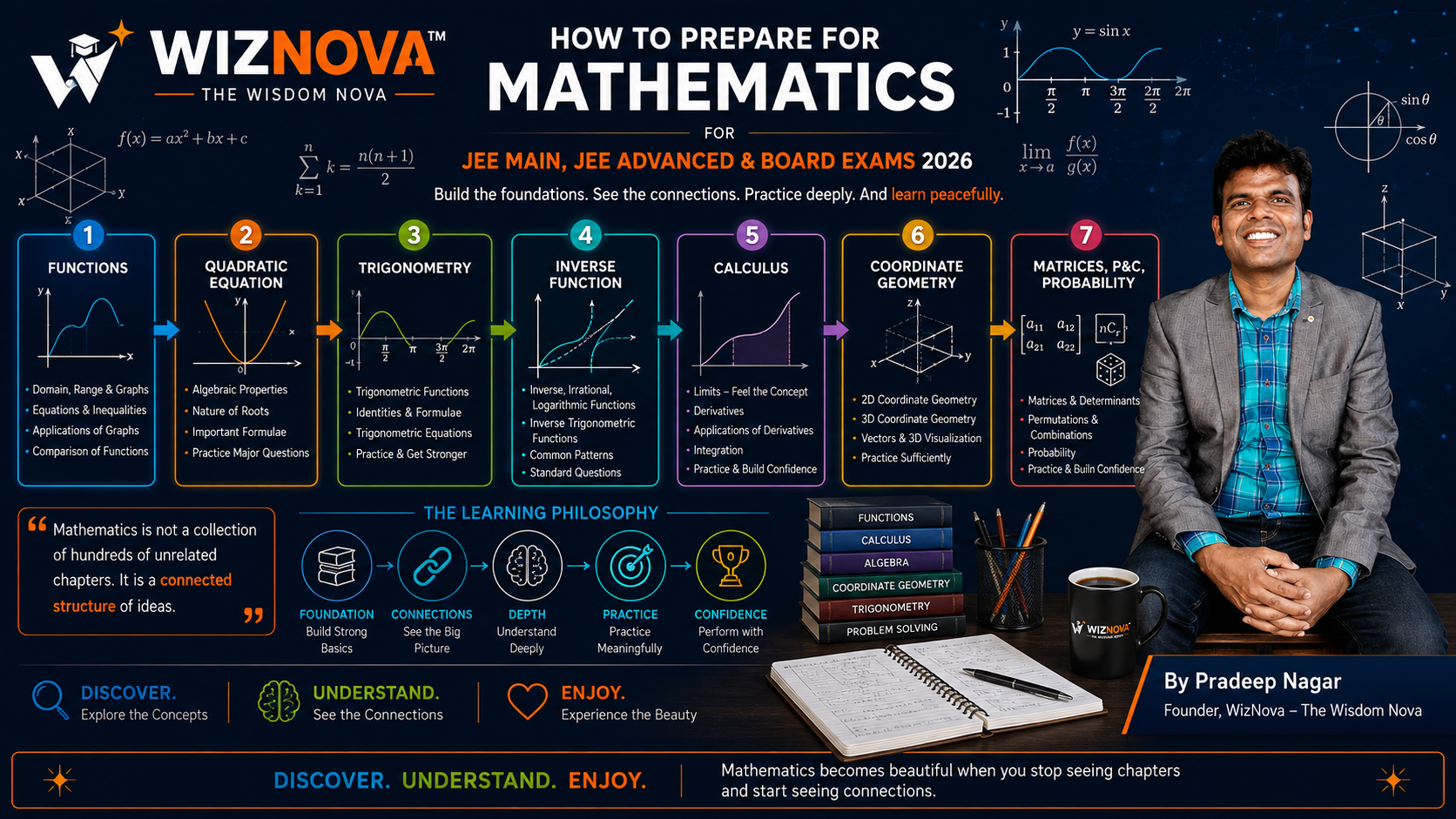
Build the foundations. See the connections. Practise deeply. And learn peacefully.
Mathematics can look enormous when you first see the JEE Main, JEE Advanced and Board examination syllabus. There are functions, algebra, trigonometry, calculus, coordinate geometry, vectors, complex numbers, probability and many other topics.
But there is a beautiful way to look at it. JEE Mathematics is not really a collection of hundreds of unrelated chapters. Many of those chapters are connected through a small number of fundamental ideas.
If you understand those foundations properly, learn to see the connections between topics, and practise enough questions to develop confidence, the entire subject becomes much more manageable. This is the approach I recommend.
Mathematics is a connected structure of ideas. Strong fundamentals lead to understanding connections; meaningful practice builds confidence.
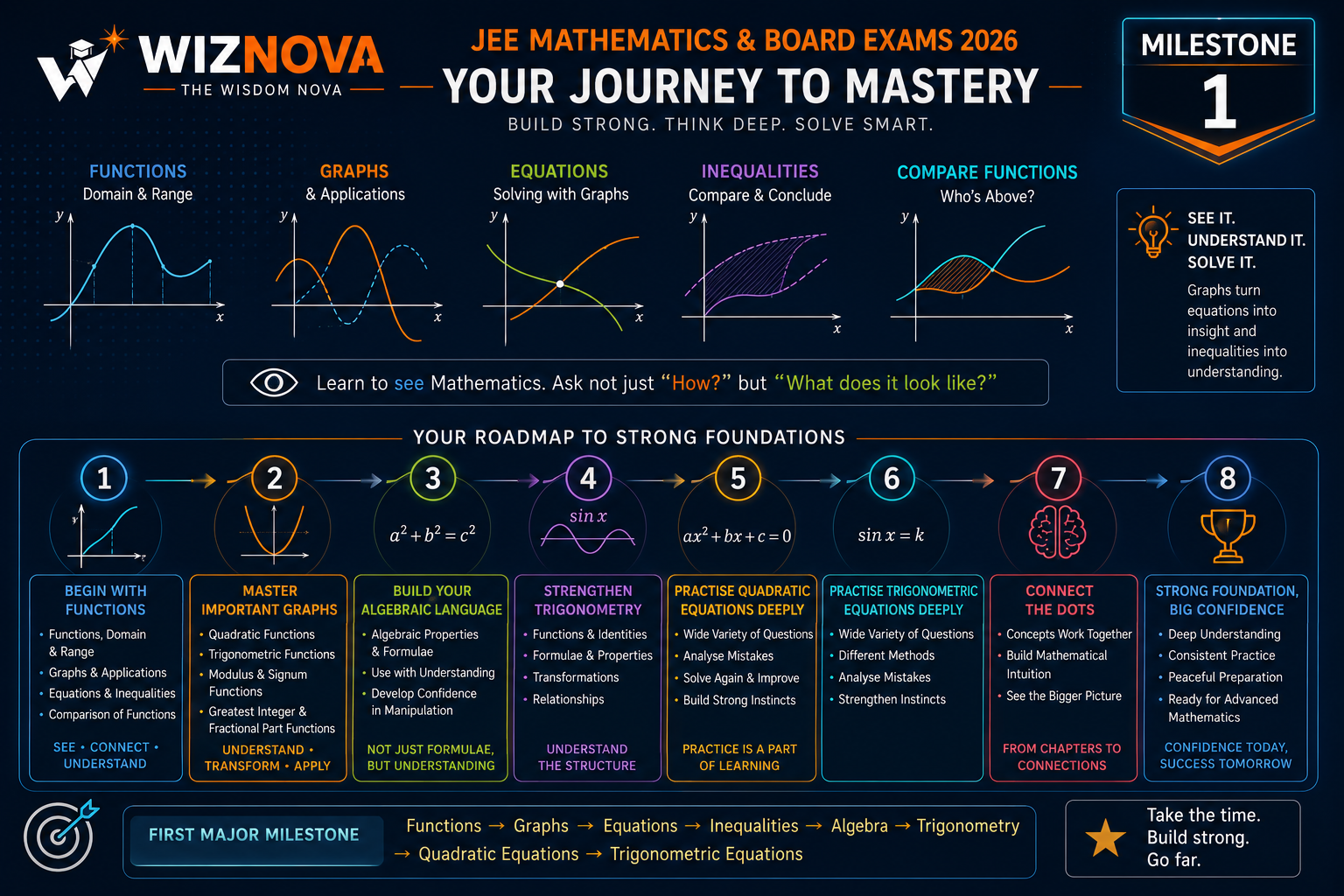
1. Begin with the real foundation: Functions
If I had to identify one starting point for serious preparation in Mathematics, I would start with Functions. Before trying to solve difficult JEE problems, develop a strong understanding of:
- Functions, domain and range
- Graphs and applications of graphs
- Equations and inequalities
- Comparison of functions
One particularly powerful connection is this: equations and inequalities can often be understood through graphs. The solutions of an equation can be viewed as points where appropriate graphs intersect. Similarly, inequalities can be understood by comparing graphs and identifying the intervals where one function lies above or below another.
This way of thinking is much more powerful than memorising isolated procedures. Learn to see Mathematics. Do not only ask, “How do I solve this equation?” Also ask, “What does this equation look like geometrically?” That question will stay with you throughout JEE Mathematics.
2. Master the important graphs
Once the basic graph concept is clear, become comfortable with the graphs of important functions:
- Quadratic functions
- Basic trigonometric functions
- Modulus and signum functions
- Greatest Integer Function and Fractional Part Function
Do not learn these graphs merely as pictures to memorise. Understand how they behave and how transformations change a graph. A graph can help you understand the number and nature of solutions, intersections, inequalities, maxima and minima, and increasing or decreasing behaviour.
Graphical thinking becomes one of your most powerful tools in JEE Mathematics.
3. Build your algebraic language
Now strengthen your algebra. Learn important algebraic properties and formulae properly, but remember: a formula is useful only when you understand when and why to use it.
The goal is not to collect formulae. The goal is to develop an algebraic language that allows you to manipulate mathematical expressions confidently.
Then move into Trigonometry. Learn trigonometric functions, fundamental identities, formulae, properties, transformations, and relationships between different trigonometric expressions. Again, do not treat Trigonometry as a collection of identities. Try to understand the structure behind them.
4. Practise quadratic and trigonometric equations deeply
Quadratic Equations and Trigonometric Equations are extremely valuable because they teach you how mathematical ideas come together. Practice a wide variety of questions.
Do not stop after understanding the theory. Solve. Make mistakes. Analyse those mistakes. Solve again. The more meaningful questions you practise, the stronger your mathematical instincts become.
In JEE Mathematics, practice is not separate from learning. Practice is a part of learning.
5. Reach the first major milestone
When you have worked carefully through this sequence, you have built a strong foundation:
Functions → Graphs → Equations → Inequalities → Algebra → Trigonometry → Quadratic Equations → Trigonometric Equations
At this stage, you should begin to feel that Mathematics is not a collection of disconnected chapters. You are beginning to see connections, and that is exactly what you need for advanced Mathematics.
Do not rush this stage. Give it proper time. Learn peacefully. Practise sufficiently. Build confidence. Once these fundamentals are strong, you have developed the capability to understand the larger structure of JEE Mathematics.
6. Return to Functions and go deeper
After your foundation is strong, return to Functions and explore them at a deeper level:
- Inverse Functions
- Irrational Functions
- Logarithmic Functions
- Inverse Trigonometric Functions
Although these topics may initially look different, try to feel the common patterns among these families of functions. Do not learn each chapter independently. Ask what is common between them, what changes from one family to another, and how their domains, ranges and graphs behave.
Then practise standard and important questions from all these families.
7. Use composite functions to test understanding
Now learn the graphs of composite functions. This is a beautiful stage in your development. If you can confidently draw and understand the graph of a complicated composite function, you are no longer merely applying formulas. You are beginning to think like a mathematician.
A useful personal benchmark is: Can I visualise the function before I start calculating? The stronger your answer becomes, the stronger your Mathematics becomes.
8. Start Calculus with patience
Once the function foundation is strong, begin Calculus. Give Limits proper time. Do not rush through Limits simply because you want to finish the syllabus.
Try to feel the beauty of the concept. Understand what a limit is trying to express. Solve questions, make mistakes, analyse them, and solve more. Eventually, you should develop confidence in Limits rather than merely remembering standard methods.
9. See why Calculus becomes familiar
Once your foundations in equations, functions and trigonometry are strong, many ideas in Calculus begin to feel familiar. You will repeatedly encounter functions, equations, comparisons, graphs, changes, patterns and problem-solving strategies.
Many questions require the same fundamental style of thinking you developed earlier while studying quadratic and trigonometric equations. Do not think of Calculus as a completely new mathematical world. It is another beautiful layer built on the foundations you have already created.
Complete the remaining Calculus topics and practise sufficiently to develop confidence.
10. Move to Coordinate Geometry
Now start Coordinate Geometry. Study both 2D Geometry and 3D Geometry properly. But again, do not study every chapter as an isolated island. Find the common connections between different parts of Coordinate Geometry.
Develop a strong feeling for the connection between Algebra ↔ Equations ↔ Geometry ↔ Graphs. Notice the role of quadratic equations and algebra in 2D Coordinate Geometry. In 3D Geometry, understand the importance of vectors.
Do not merely calculate in 3D. Learn to visualise. When you read a 3D question, try to create the picture in your mind. The ability to visualise can transform your understanding of 3D Geometry. Then practise enough questions in both 2D and 3D to develop confidence.
11. Continue through Complex Numbers, Series and Binomial
Now move to Complex Numbers. If your quadratic-equation foundation is strong and you have developed a good understanding of vectors and geometric thinking, you may find Complex Numbers much more natural. Look for connections rather than treating it as a completely isolated topic.
Next, move to Sequence and Series and the Binomial Theorem. Continue the same approach:
Understand → Connect → Practise → Analyse → Improve
Do not measure progress only by the number of chapters completed. Measure it by the number of ideas you can confidently use.
12. Give independent algebra topics dedicated time
Finally, come to topics such as Matrices and Determinants, Permutations and Combinations, and Probability. These topics have their own character and can feel somewhat different from the flow of Functions, Algebra, Calculus and Coordinate Geometry. That is perfectly fine.
They may not connect as naturally with the larger chain we have discussed, so give them dedicated time. Learn the concepts, practise standard problems, then move towards higher-level problems. Once again, build confidence through practice.
13. The complete learning journey
The following roadmap is not a random list of chapters. It is a connected learning journey:
- Functions
- Domain, Range and Graphs
- Equations and Inequalities
- Algebra and Trigonometry
- Quadratic and Trigonometric Equations
- Strong Foundation
- Inverse, Irrational, Logarithmic and Inverse Trigonometric Functions
- Composite Functions and Graphs
- Calculus: Limits to remaining Calculus
- Coordinate Geometry: 2D and 3D
- Complex Numbers
- Sequence and Series
- Binomial
- Matrices and Determinants
- Permutations and Combinations
- Probability
Foundation → Connections → Depth → Practice → Confidence
14. What about Board Mathematics?
The conceptual foundation described above is extremely useful for Board Mathematics as well. But Board examinations have their own answer-writing requirements.
Board preparation should include:
- Writing complete solutions and appropriate steps
- Using correct mathematical notation
- Practising textbook and example-style questions
- Solving previous Board papers
- Working within examination time
- Presenting answers clearly
For JEE, you need conceptual depth, speed, accuracy and problem-solving ability. For Boards, you additionally need clear mathematical presentation and answer-writing discipline. The underlying Mathematics is common, but the examination strategy is not identical.
15. Do not be afraid of the syllabus size
When you look at the complete JEE Mathematics syllabus, it can appear intimidating. Do not think, “I have so many chapters to finish.” Instead think, “I have a sequence of ideas to understand.”
Functions lead naturally into graphs. Graphs connect with equations and inequalities. Algebra and Trigonometry become foundations for later problem solving. Functions return in more advanced forms. Those ideas flow into Calculus. Algebra and geometry connect in Coordinate Geometry. Vectors help you understand 3D.
Gradually, the apparently huge syllabus begins to look like a connected mathematical landscape.
16. The most important advice
Do not rush Mathematics. Mathematics rewards depth. If a concept is not clear, give it time. If you are making mistakes, analyse them. If a question seems difficult, do not immediately look for the solution.
Think. Try. Draw. Compare. Experiment. Then look at the solution and understand why it works. Then solve a similar problem yourself.
The more you practise, the stronger you become. But practice should not mean blindly solving hundreds of questions. Understand the idea. Practise meaningful questions. Analyse your mistakes. Revisit the concept. Practise again. That is how confidence is built.
17. One last thought
You do not need to know everything on Day 1. You do not need to solve the hardest JEE Advanced problem immediately. You do not need to rush because someone else has finished five chapters.
Give yourself the time required to build the foundation. Once the foundation becomes strong, Mathematics starts becoming less about remembering and more about seeing. You begin to see patterns, connections, graphs behind equations, geometry behind algebra, and familiar ideas appearing in unfamiliar questions.
Eventually, you start enjoying the subject.
Learn patiently. Practise deeply. Build confidence. The JEE Mathematics syllabus may be large, but the underlying ideas are beautifully connected.
About the Author
Pradeep Natthisingh Nagar is an Indian film producer, educationist, entrepreneur, and author who transitions seamlessly between the worlds of high-level science, academia, and regional cinema.
He made his foray into mainstream filmmaking as a producer with the critically acclaimed Marathi political-drama feature film, Khurchi. Through his media and publishing venture, WizNova™ (The Wisdom Nova), Nagar focuses on backing meaningful, inspirational, and socially relevant content that bridges entertainment with thought-provoking storytelling.
Early Life and Scientific Career
Born with a deep aptitude for analytical thinking, Pradeep pursued his higher education at the prestigious Indian Institute of Technology (IIT) Bombay, graduating with a Bachelor of Technology (B.Tech.) degree in Electrical Engineering.
Following his graduation, he was appointed as a Class I Gazetted Defence Scientist with the Defence Research and Development Organisation (DRDO). During his tenure at DRDO, Nagar worked on critical national defence projects, specializing in complex missile control, aerodynamics, and guidance systems.
Educational Eminence
Driven by a passion for mentoring the next generation, Nagar shifted from defence research to the education sector. Over the course of a distinguished career spanning more than 20 years, he established himself as a Mathematics educator for the highly competitive IIT-JEE examinations.
As a Mathematician and Director at Prime Academy Pune, he has personally trained and mentored thousands of students, helping them secure admissions into top-tier Indian Institutes of Technology.
Literature and Film Production
In addition to his academic and cinematic pursuits, Nagar is a published author. He penned the conceptual mathematics textbook, There Is Fun in Functions, aimed at breaking down complex mathematical principles for students.
His commitment to storytelling led to the creation of WizNova™ — a multidimensional platform spanning publishing, digital media, podcasts such as The IIT Journey and Wisdom Conversations, and mainstream film production.
With Khurchi, Nagar furthered his vision of creating impactful cinema, positioning himself as a creative voice working across education, science, literature, and Indian regional cinema.
Continue learning
Explore Topics
Written by
Pradeep Nagar
Content creator and writer sharing insights and stories.